
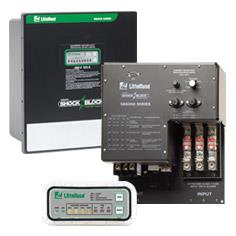
Images are representations only.
SB6100 Series Ground-Fault Circuit Interrupter
Brand: Littelfuse, Inc.Special-Purpose Ground-Fault Circuit Interrupter (GFCI),
Class C and Class D
Industrial Shock Block (ISB) is a personnel protection device designed to
meet the new requirements for special-purpose GFCIs defined by UL 943C.
ISB is the first permanently connected Class C and Class D GFCI on the
market. Class C GFCIs are intended to be used on three-phase systems
where the line-to-line voltage is 480 V or less with a trip level of 20 mA,
while Class D GFCIs are intended to be used on 600 V systems. These
improvements to the standard Class A GFCI (6 mA trip level used on 240 V
systems or less) were made to allow the use of GFCIs in industrial facilities.
The ISB includes an automatic self-test feature and is compliant to the
UL1998 Software in Programmable Components standard.
Equipment Ground-Fault Protective Device (EGFPD)
ISB is also available with adjustable protection settings as an EGFPD. The
EGFPD models can be set to trip at 6 mA or from 10-100 mA in increments
of 10 mA. This offers more flexibility since GFCI devices are not allowed to
have an adjustable trip level.
Rating and Models
ISB (GFCI & EGFPD) is available for three-phase voltages from 208 to 600
V with a maximum full load current of 100 A, and a built-in overcurrent
protection supplied by Littelfuse Class T fuses. The load must be 3-phase,
however, cannot have a neutral. The power system can either be solidlygrounded
or high-resistance grounded.
Two options for enclosures are available: UL-recognized open-chassis models
are available for installation in existing electrical enclosures and UL-listed
enclosed models include a NEMA-4X enclosure for stand-alone installations.
Ground Wire (Load-Ground) Monitor
The ISB also monitors the ground wire (load-ground) connection between the
ISB and load. This is a required feature for GFCI devices and is optional for
EGFPD devices. If the connection is broken, the ISB will provide an alarm by
changing the state of the alarm contacts. This monitoring circuit includes an
extra wire (pilot wire) between the ISB and load (since the monitoring current
is low, only a small wire is required). At the load, the pilot wire is connected to
a termination device. The other end of the termination device is connected to
the load ground (typically the enclosure).